Los Angeles
Downtown Los Angeles: How the City Reinvented Its Own Centre
January 11, 2026
Once avoided, now essential. Downtown Los Angeles is where the city has redefined itself — but only if you understand how to move through it.
Los Angeles has never depended on a single center.
The city extends horizontally, distributing its identity across multiple districts that operate with relative independence. For decades, Downtown Los Angeles existed within this structure as an exception — present, but not essential. It functioned as an administrative and financial core, active during the day and largely abandoned at night, disconnected from the cultural and social life that defined the rest of the city.
This condition has changed, but not through a single transformation. Downtown has not been replaced. It has been reconfigured — gradually, unevenly, and with a level of complexity that resists simple definition. Different areas within it have evolved at different speeds, producing a landscape that is both renewed and fragmented.
TravelScope approaches Downtown Los Angeles not as a unified district, but as a sequence of environments — each with its own structure, rhythm, and level of integration into the broader city.

The Structure: A Center Without Continuity
Downtown Los Angeles is often described as a center, but it does not function as one in the conventional sense.
Rather than forming a continuous environment, it is composed of adjacent districts that differ significantly in atmosphere and use. The Financial District, the Historic Core, the Arts District, and Bunker Hill exist within close proximity, but they do not merge seamlessly. Transitions between them are perceptible, sometimes abrupt.
This fragmentation is not a flaw. It is the defining characteristic of Downtown. Understanding it requires abandoning the expectation of continuity and replacing it with a model based on sequence.
Movement becomes the organizing principle.
Bunker Hill: Elevated Space and Cultural Density
Bunker Hill represents one of the most visible transformations within Downtown.
Elevated above the surrounding streets, it concentrates cultural institutions and architectural landmarks into a relatively compact area. The Walt Disney Concert Hall, The Broad, and MOCA define the district, creating a space that is structured, accessible, and visually coherent.
Movement here is vertical as well as horizontal. Escalators, steps, and terraces connect different levels, and the experience unfolds through transitions in elevation.
This is one of the few areas of Downtown that feels intentionally organized. It provides an entry point, but not a complete representation.
The Historic Core: Layers of Continuity
Moving into the Historic Core introduces a different condition.
Buildings reflect earlier phases of the city’s development, and the environment retains a level of density that contrasts with the openness of Bunker Hill. Streets are narrower, signage more varied, and the relationship between interior and exterior spaces more direct.
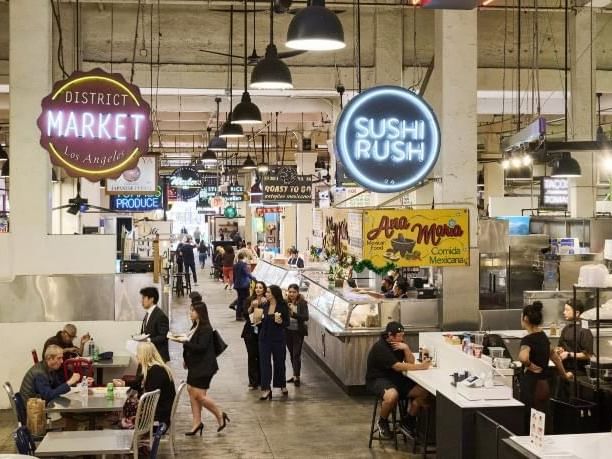
Grand Central Market operates as a focal point within this area, not as an isolated attraction, but as part of a broader network of activity. The streets around it extend the experience outward, creating continuity through repetition rather than design.
The Historic Core is less curated, more layered, and more reflective of the city’s past.
The Arts District: Expansion and Reinterpretation
East of the Historic Core, the Arts District introduces another shift.
Former industrial spaces have been repurposed into galleries, studios, cafés, and restaurants, producing an environment that is more open and less constrained by traditional street structure. Buildings are lower, streets wider, and the relationship between interior and exterior more fluid.
This area reflects a different phase of Downtown’s evolution — one that prioritizes adaptation over preservation. The result is a district that feels both established and in transition.
Movement here is less guided. Exploration replaces direction.
The Financial District: Scale Without Presence
The Financial District defines the skyline of Downtown, but not necessarily its experience.
Tall buildings, wide streets, and large open spaces create a sense of scale that is more aligned with infrastructure than with daily life. During working hours, the area is active. Outside of them, it becomes quieter, sometimes to the point of absence.
This contrast highlights a central aspect of Downtown: not all areas operate under the same conditions at all times.
Understanding when and where activity concentrates is as important as understanding where to go.
The Movement: Walking as Strategy
Downtown Los Angeles is one of the few areas of the city where walking is not only possible, but necessary.
Distances between districts are manageable, but the experience depends on movement rather than arrival. Walking allows transitions to become visible — the shifts in architecture, density, and atmosphere that define the area.
This movement requires awareness. Certain routes are more effective than others, and timing influences safety and accessibility. The objective is not to wander without direction, but to move with intention.
Downtown is not discovered passively. It is navigated.
The Time: When to Go
Timing affects Downtown more than most areas of Los Angeles.
Daytime provides structure. Offices are open, streets are active, and movement is consistent. Evening introduces variation. Some areas become more active — particularly around dining and cultural venues — while others reduce significantly.
Late night reduces activity further, and certain areas become less accessible.
The most effective approach is to align movement with time — selecting areas that correspond to the conditions under which they function best.
The Perception: Changing Expectations
Downtown Los Angeles has historically been perceived as a place to avoid, particularly outside of working hours.
While this perception has changed, it has not disappeared entirely. The reality is more nuanced. Some areas have been transformed, others remain in transition, and the overall environment reflects this complexity.
Approaching Downtown requires adjusting expectations. It is not uniformly polished, nor is it uniformly unstable. It is a mix of both.
Understanding this allows for a more accurate experience.
The Limit: What Downtown Is Not
Downtown Los Angeles is not the definitive expression of the city.
It does not replace areas such as Santa Monica, Silver Lake, or West Hollywood. It complements them. Its value lies in offering a different structure — one that is more concentrated, more vertical, and more layered.
Expecting it to function as the sole center of Los Angeles leads to misinterpretation. Recognizing it as one part of a distributed system clarifies its role.
Closing
Downtown Los Angeles is often framed as a city within a city — a space that has undergone transformation and now demands attention.
What defines it is not a single identity, but a series of transitions. Districts connect without merging, activity concentrates without spreading evenly, and the experience depends on movement rather than presence in a single location.
To understand Downtown is not to find its center, but to move through its structure — to recognize how it has been reconfigured, and how, within that reconfiguration, a different version of Los Angeles has emerged.
📍 Explore Los Angeles in depth — read the full TravelScope Los Angeles Experience Guide →
/experiences/los-angeles-travel-guide