Amsterdam
Cycling Amsterdam: Why the Bicycle Changes Everything
December 21, 2025
In Amsterdam, cycling is not an activity but a system. Understanding it changes how you see — and move through — the city.
Amsterdam is often described through its canals, architecture, and museums, but nothing defines the city as clearly as the bicycle. Cycling here is not an activity added to the urban experience. It is the structure that organizes it. To move through Amsterdam without a bike is to observe the city from the outside. To cycle is to enter its system.
The difference is immediate. Distances that feel separate on foot become continuous, and the city — which at first seems like a series of districts — resolves into a single, connected surface. Movement becomes fluid, directional, and constant, shaped less by routes than by rhythm. What once required planning becomes instinct.
TravelScope approaches cycling in Amsterdam not as a practical suggestion, but as a shift in perspective — one that changes not only how you move through the city, but how the city reveals itself in return.

The System: A City Designed for Movement
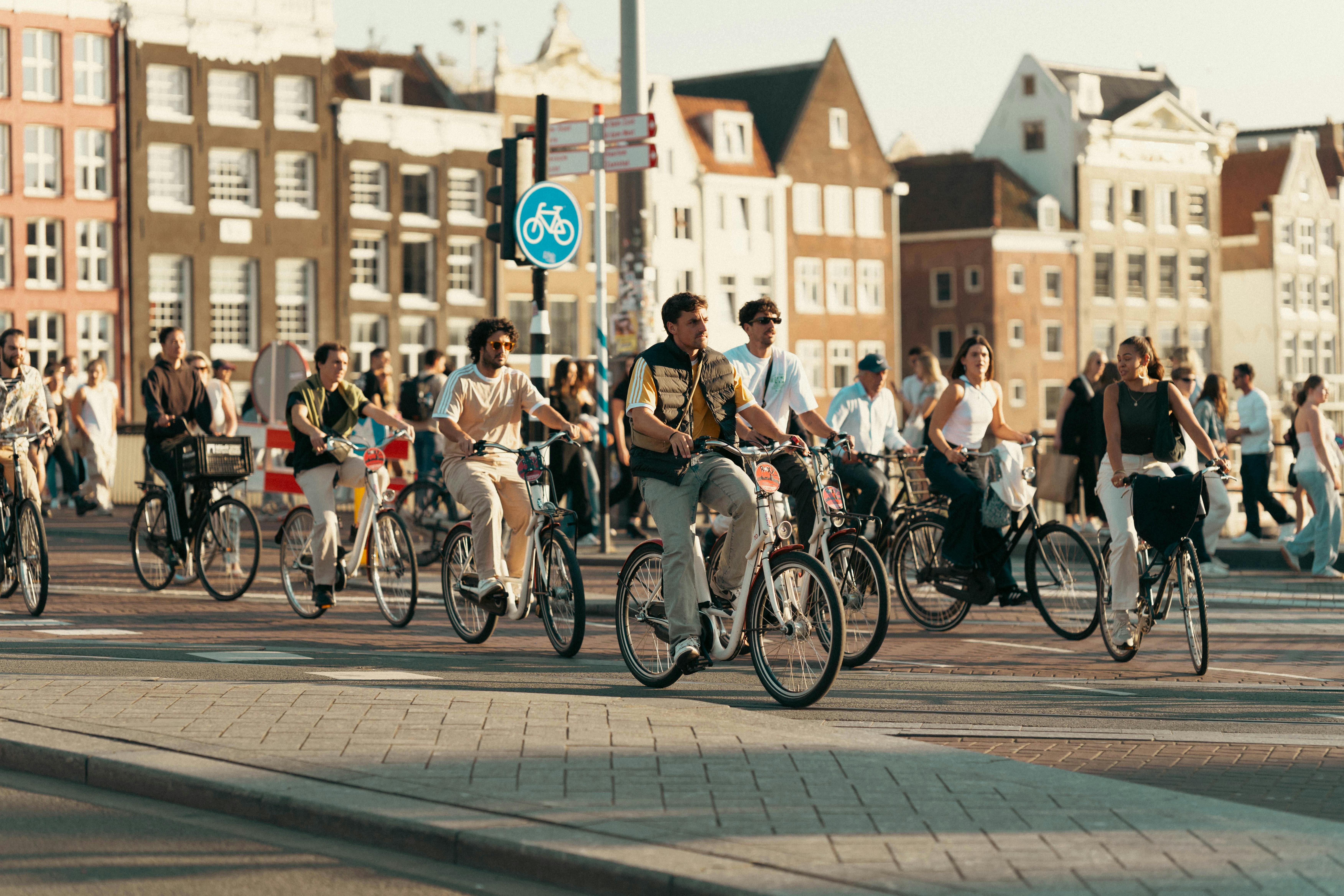
Amsterdam’s cycling culture is often presented as a lifestyle, but in practice it functions as infrastructure. The bicycle is not an alternative form of transport; it is the default around which the rest of the city has been organized. Roads are calibrated for it, intersections are structured around it, and daily life moves at its pace.
This produces a system that feels, at first encounter, both highly structured and almost invisible. There are rules — clear ones — but they are not always explicitly signposted. They are embedded in behavior. Cyclists maintain a steady flow, rarely stopping completely, adjusting continuously to the movement of others. The result is not chaos, but a form of collective coordination that operates without friction.
To enter this system as a visitor is to adapt quickly. Observation becomes participation almost immediately, and the learning curve is less about technique than about awareness.
The First Ride: Entering the Flow
The first minutes on a bicycle in Amsterdam are rarely comfortable. The density of movement, the proximity of other cyclists, and the speed at which decisions must be made can feel overwhelming — particularly for those accustomed to cities where cycling is marginal.
And yet, this discomfort does not last. The system absorbs you. What initially appears fast begins to feel normal. What seems unstructured reveals its internal logic. You begin to anticipate rather than react — reading the position of cyclists ahead, adjusting your speed without conscious effort, aligning yourself with the flow rather than resisting it.
This is the moment at which Amsterdam shifts. The city is no longer something you move through cautiously. It becomes something you move with.
The Routes: How the City Connects Itself
The value of cycling in Amsterdam is not in reaching specific destinations, but in understanding how those destinations relate to one another through movement.
Ride along the major canals — Prinsengracht, Keizersgracht, Herengracht — where the relationship between water, architecture, and motion becomes most apparent. Continue outward into neighborhoods such as the Jordaan, De Pijp, and Amsterdam Oost, where the scale shifts and the density adjusts without breaking continuity.
Bridges become transitions rather than obstacles. Intersections become moments of negotiation rather than interruption. The city reveals itself not as a collection of highlights, but as a network.
The most effective way to experience this is to avoid rigid planning. Choose a direction, not a route. Allow detours. Follow instinct. The system is designed to support this kind of movement.
The Rules You Don’t See
Amsterdam’s cycling culture functions through a set of rules that are rarely stated but consistently followed.
Movement is predictable. Sudden stops are avoided. Direction is communicated through positioning rather than gesture. Awareness extends in all directions — not only forward, but behind and to the side.
For visitors, the instinct to hesitate can be more disruptive than small mistakes. Confidence — even imperfect — integrates more smoothly into the flow than uncertainty. The system accommodates adjustment, but not hesitation.
This does not mean that the environment is unforgiving. On the contrary, it is remarkably tolerant. But it expects participation.
The City at Different Hours
Cycling in Amsterdam changes with time, and each variation reveals a different version of the city.
In the early morning, movement is light and continuous. The streets are quiet, the canals reflective, and the pace measured. This is the most accessible moment for those unfamiliar with the system — a time to adjust, to understand, and to move without pressure.
By midday, density increases. The flow becomes more complex, intersections more active, and the proportion of visitors rises. The system remains functional, but the margin for hesitation narrows.
At night, the city shifts again. The pace softens, the lights reflect off the water, and movement becomes less directional, more atmospheric. Cycling after dark is not less intense, but differently structured — quieter, more dispersed, and often more memorable.
Weather, Wind, and Reality
Amsterdam’s cycling culture is not dependent on ideal conditions. Rain, wind, and cold are not exceptions — they are part of the system.
The wind, in particular, defines the experience more than most visitors expect. It reshapes effort, alters routes, and introduces a physical dimension that is absent in still conditions. Cycling against it is work. Cycling with it is effortless.
Rain changes texture rather than structure. The city continues to move. Surfaces reflect light differently, sounds soften, and the experience becomes more enclosed, more immediate.
To cycle in Amsterdam is to accept these conditions rather than avoid them. They are not interruptions. They are part of the environment.
The Limit: When Not to Cycle
Despite its centrality, the bicycle is not always the optimal way to move through Amsterdam.
In the historic core, particularly during peak hours, density can reach a point at which fluidity is reduced. In these moments, stepping out of the system — walking, pausing, observing — restores balance.
Understanding when to leave the bicycle is part of understanding how to use it.
Closing
Amsterdam is often experienced as a sequence of images — canals, houses, reflections — but these are static representations of a city defined by movement.
Cycling reveals that movement. It transforms distance into continuity, observation into participation, and the city itself into something that is not simply seen, but navigated from within.
To understand Amsterdam, it is not enough to look at it. You have to move with it.
📍 Explore Amsterdam in depth — read the full TravelScope Amsterdam Experience Guide →
/experiences/amsterdam-travel-guide