Nassau
Arawak Cay: Where Nassau’s Real Food Culture Lives
January 14, 2026
Away from resorts and controlled spaces, Arawak Cay reveals how Nassau actually eats — informal, direct, and rooted in repetition.
Nassau is often experienced through its resorts.
The structure is familiar — controlled environments, defined access, and a version of the Caribbean that prioritizes clarity and comfort. These spaces operate efficiently, but they also compress the city into something simplified, detached from the patterns that define it beyond their boundaries.
Arawak Cay exists outside this structure.
Located a short distance from downtown, along the waterfront, it is known locally as the Fish Fry — a sequence of restaurants, stalls, and informal spaces that operate continuously throughout the day and into the night. Here, Nassau does not present itself as a destination. It functions as a system.
TravelScope approaches Arawak Cay not as a place to eat, but as a place to understand how the city moves when it is not organized for visitors — how food, space, and routine intersect to produce something that is both immediate and sustained.
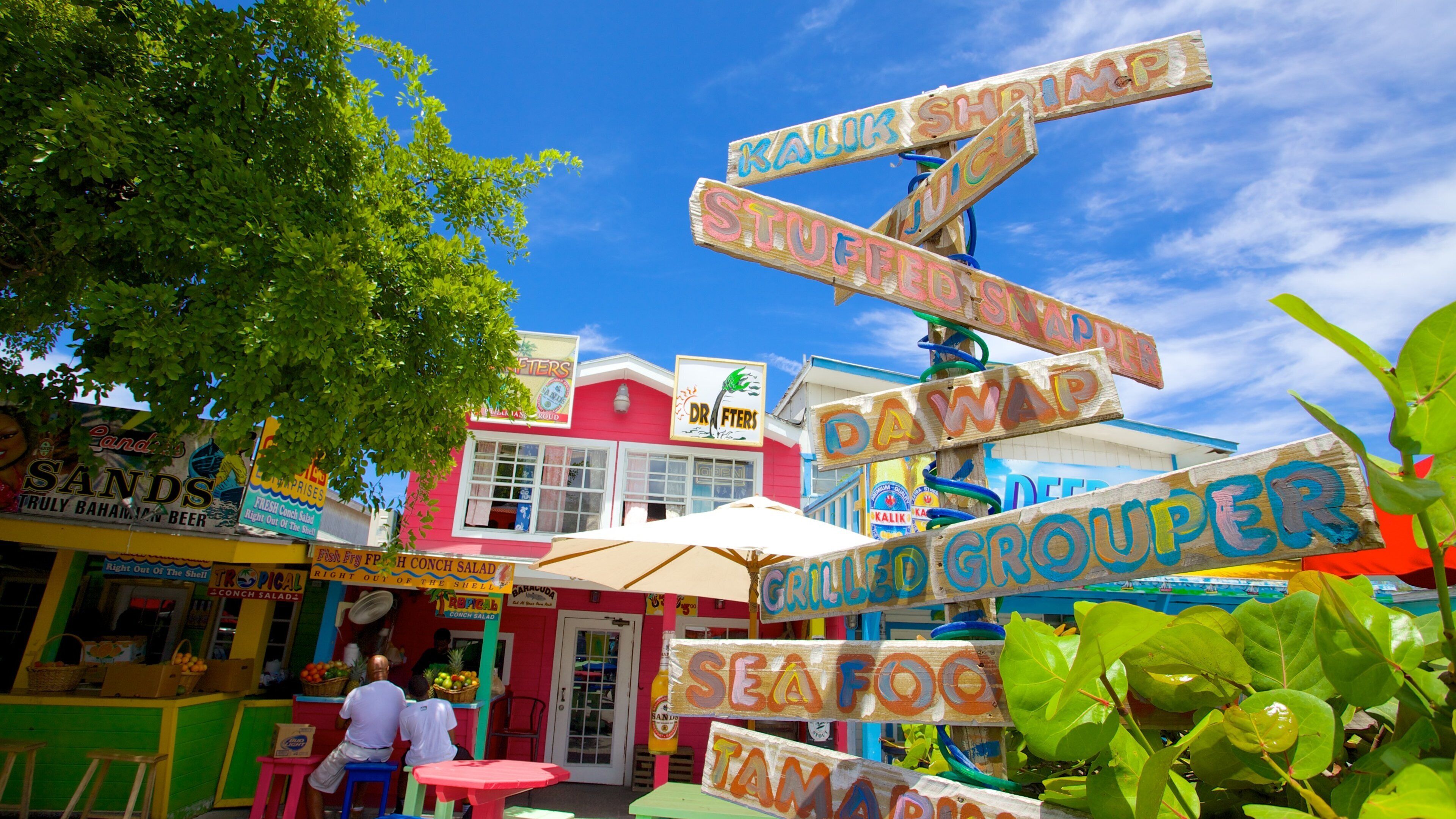

The Structure: Informality as System
Arawak Cay appears informal, but it is not unstructured.
Restaurants line the street in a sequence that feels continuous rather than segmented. Each space extends outward — tables, music, signage — creating an environment in which boundaries between interior and exterior are minimal. Movement occurs across these thresholds without interruption.
There is no central entry point, no defined beginning. The experience starts wherever you enter it and develops as you move through it.
This lack of formal organization does not produce disorder. It produces flexibility.
The Food: Identity Through Repetition
Food at Arawak Cay is not presented as variety for its own sake.
Certain dishes define the area — conch salad, fried snapper, cracked conch, grilled lobster — repeated across multiple locations, each with slight variations. The differences are not always visible at first. They become apparent through comparison.
This repetition is not limitation. It is refinement.
Choosing where to eat is less about identifying the “best” option and more about engaging with the system — observing, selecting, and, if time allows, repeating.
The experience is cumulative.
The Movement: Eating as Flow
Eating at Arawak Cay does not follow a single sequence.
You arrive, you look, you choose — but these actions are not fixed. Movement continues even while eating. People pass, music overlaps, conversations extend beyond individual tables.
There is no separation between dining and environment. You are part of the space, not positioned outside it.
This changes the pace. Meals extend, but not in a static way. They integrate into the flow.
The Sound: Music as Structure
Sound defines Arawak Cay as much as food.
Music is constant — from individual restaurants, from passing cars, from speakers that overlap without coordination. Genres mix, rhythms intersect, and the result is a continuous layer that shapes the atmosphere.
This is not background noise. It is structural.
Silence is not expected. The environment depends on sound to maintain its energy.
The Timing: Day vs Night
Arawak Cay changes with time, but does not transform completely.
During the day, the pace is slower. Light is direct, movement more controlled, and the environment feels more open. It is easier to read, to understand its structure.
At night, density increases. Music intensifies, spaces fill, and the environment becomes more compressed. The experience shifts from observation to immersion.
Neither is better. They reveal different aspects of the same system.
The Edge: Water and Openness
Arawak Cay is positioned along the water, and this defines part of its character.
The openness of the coastline contrasts with the density of the street. Air moves differently, space extends outward, and the horizon remains visible beyond the activity.
This edge stabilizes the environment. It prevents the density from becoming closed.
The Interaction: Local and Visitor
Arawak Cay is not exclusively local, nor exclusively oriented toward visitors.
Both are present, but the space does not adjust itself significantly to accommodate one over the other. The system continues regardless of who enters it.
This creates a different kind of interaction. You are not guided. You are integrated.
Understanding this changes expectations. Service is direct, not curated. Engagement is immediate.
The Limit: What It Is Not
Arawak Cay is not a refined dining environment.
It is not designed for privacy, nor for controlled pacing. Quality varies, service can be uneven, and the experience depends on participation.
Expecting something else reduces its value.
It is also not representative of all Nassau. It is one expression of it — concentrated, visible, and accessible.
Closing
Arawak Cay is often described as the place to try local food in Nassau, but this description captures only part of what it offers.
What defines it is not only the food, but the system that surrounds it — the way space is used, how movement occurs, and how routine sustains the environment without formal structure.
To experience it fully is not to select a single restaurant, but to enter the flow — to move, observe, and participate in a space that operates continuously, without needing to present itself as anything other than what it is.
📍 Explore Nassau in depth — read the full TravelScope Nassau Experience Guide →
/experiences/nassau-travel-guide

